
CONGRATULATIONS!
You've made it to underwriting and if you've heard stories about this stage, you've probably heard some wild ones. Here's the reality: underwriting is simply a thorough review to confirm that your loan meets the lender's guidelines and that you have both the ability and the willingness to repay it. It's not personal. It's a process.
What the Underwriter is Evaluating
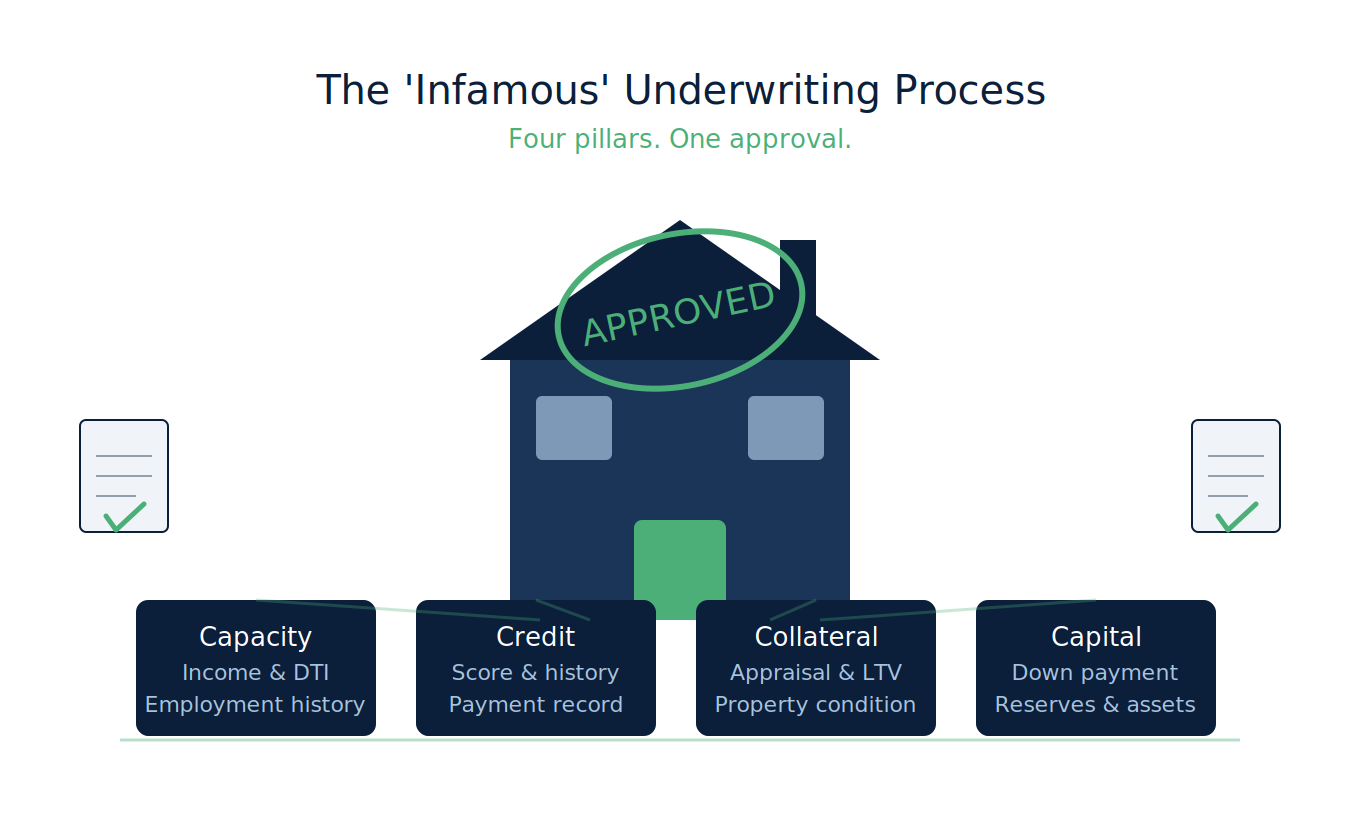
Underwriters analyze four core areas, often called "The Four C's":
Capacity is your ability to repay. This means your income, employment history, debt-to-income ratio (DTI), and how your monthly housing payment compares to what you earn.
Credit is your track record of repaying debt. The underwriter reviews your credit score, payment history, open accounts, derogatory marks, and any recent credit inquiries.
Collateral is the property securing the loan. The appraisal, property condition, and loan-to-value ratio (LTV) all play into this. The home has to support the sales price in order to give you the loan amount requested.
Capital is your assets. Down payment funds, asset reserves, and where that money came from. Large deposits may require documentation to confirm they're not an undisclosed loan.
Common Myths vs. What Actually Happens
Myth: "If you get approved once, you're approved." Reality: Underwriting is an ongoing review. Your file is checked again close to closing. A new debt, a job change, or a big purchase between approval and closing can absolutely change your outcome.
Myth: "The underwriter is trying to find a reason to deny you." Reality: Underwriters are trying to approve your loan within guidelines they're required to follow. Their job is to document that the loan is sound, not to find fault.
Myth: "A conditional approval means something is wrong." Reality: Conditions are normal. Almost every loan approval comes with conditions such as; needing updated pay stubs, a letter of explanation, or proof of insurance. Respond quickly and completely, and most conditions clear with no issue.
Myth: "It shouldn't take this long." Reality: Timelines vary by loan type, property, and complexity. Purchase loans with multiple income sources, self-employment, or unique properties take longer. Volume and staffing at the lender matters too. Your loan officer should keep you informed at every stage.
What You Can Do to Help
- Respond to document requests from your loan processor and loan officer immediately.
- Don't open any new credit.
- Don't make large deposits without documentation.
- And stay in close contact with your loan team, they're here to guide you through every step.